Buying guide
Granite vs quartz
Short answer
Granite is a natural stone cut from quarried blocks; engineered quartz is a manufactured surface made mostly of crushed quartz bound with resin. Granite generally copes better with heat and strong sunlight, while quartz offers more consistent colour and usually needs no sealing. Stones Forever supplies both: natural granite and a quartz range in the Calacatta, Carrara and Solid series.
- Granite is quarried and cut; every slab is different. Quartz is made in a factory, so slabs of one design look much the same.
- Quartz contains resin, so manufacturers generally advise against direct high heat and long-term outdoor sun exposure.
- Quartz is typically non-porous and needs no sealing; granite may or may not need sealing depending on the stone.
- Stones Forever supplies granite and quartz slabs, so you can compare both in one quotation.
What each material is
Granite (as the trade uses the name) is a hard natural stone made mainly of quartz and feldspar. Blocks are quarried, sawn into slabs and polished or otherwise finished. Its colour and pattern come from the minerals in that particular block, so no two slabs are identical.
Engineered quartz (often just "quartz") is a manufactured product. Crushed quartz and other fillers are mixed with polymer resin and pigments, pressed into slabs and cured. Each brand publishes its own technical data and care guidance, and that guidance is what applies to a given quartz product.
The word "quartz" causes confusion because granite itself contains quartz. When people compare "granite vs quartz", they mean natural stone against the engineered, resin-bound product.
Side by side
The quartz column describes engineered quartz in general. Always check the specific manufacturer's data sheet and care instructions before you specify a quartz product.
| Granite | Engineered quartz | |
|---|---|---|
| Made from | Natural stone, quarried and sawn | Crushed quartz and fillers bound with resin |
| Pattern | Unique to each block and slab | Designed; consistent within a production batch |
| Sealing | Depends on the stone; test before deciding | Generally not needed (follow the manufacturer) |
| Heat | Generally heat tolerant; still use trivets and avoid thermal shock | Resin can scorch or discolour; manufacturers advise against direct high heat |
| Strong sun / outdoors | Generally used outdoors, with the right colour and finish | Prolonged UV can discolour resin; most manufacturers do not recommend outdoor use |
| Matching across a large project | Needs slabs from the same block or lot | Easier, within the same batch |
| From Stones Forever | 33 granites in slabs, tiles and steps | Not stocked |
Heat and sunlight: the UAE factor
In a climate where outdoor kitchens, terraces and sun-facing windows are common, heat and UV exposure matter more than they would in many other markets. Because engineered quartz contains resin, very hot pans can leave scorch marks or discolouration, and long exposure to direct sunlight can yellow or fade some products over time. That is why quartz manufacturers generally restrict their products to indoor use.
Granite contains no resin binder in the stone itself, so it is generally the more straightforward choice for outdoor kitchens, barbecue counters and brightly lit areas. It still has limits: dark polished granite in full sun gets very hot to the touch, and many slabs are resin-treated at the factory to fill natural pits, so ask about this if a piece will be in strong sun. Our flooring in hot climates guide covers colour and finish choices outdoors.
On either surface, use a trivet rather than putting a hot pan straight down.
Consistency versus character
The strongest argument for quartz is predictability. If you are fitting dozens of identical apartment kitchens, a manufactured surface makes matching simpler.
The strongest argument for granite is that each slab is a piece of natural stone with its own depth and pattern. The trade-off is variation: slabs from different blocks can look noticeably different, so for larger projects you need slabs from the same lot and you should inspect the actual slabs before confirming. Our natural variation guide explains how to do that.
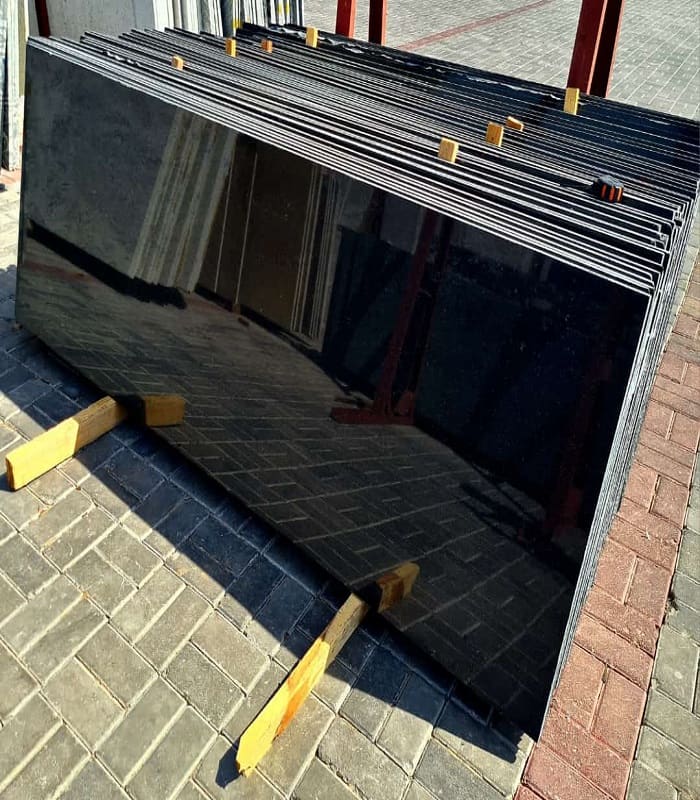
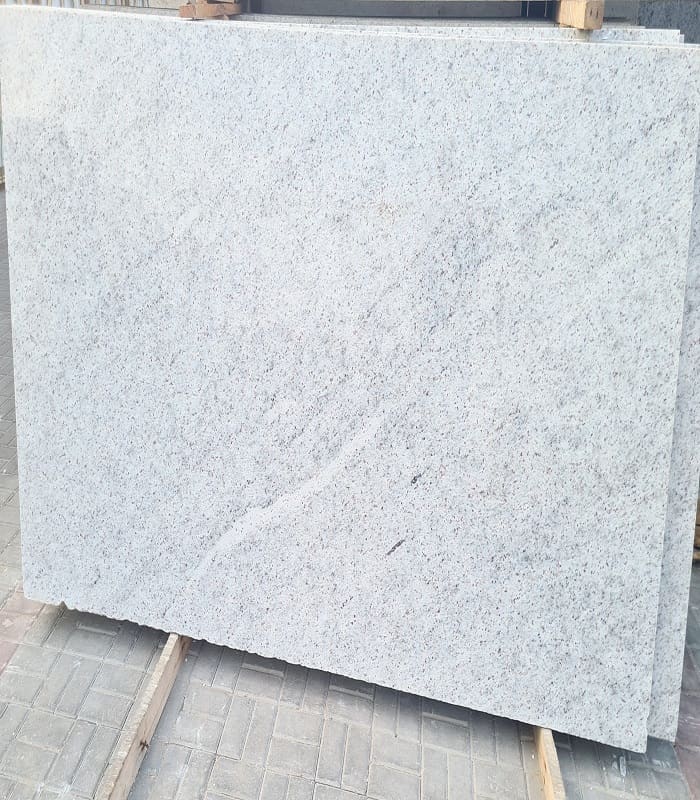
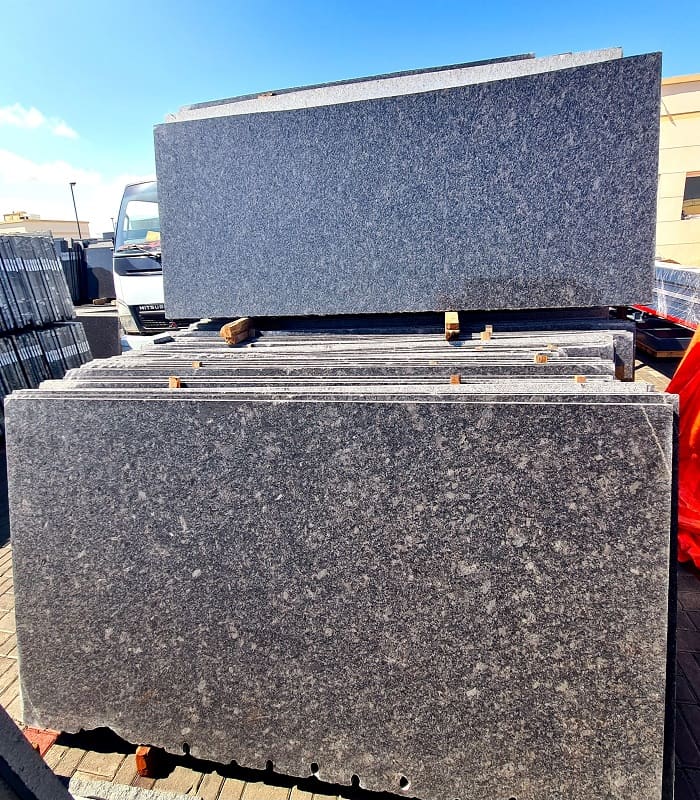
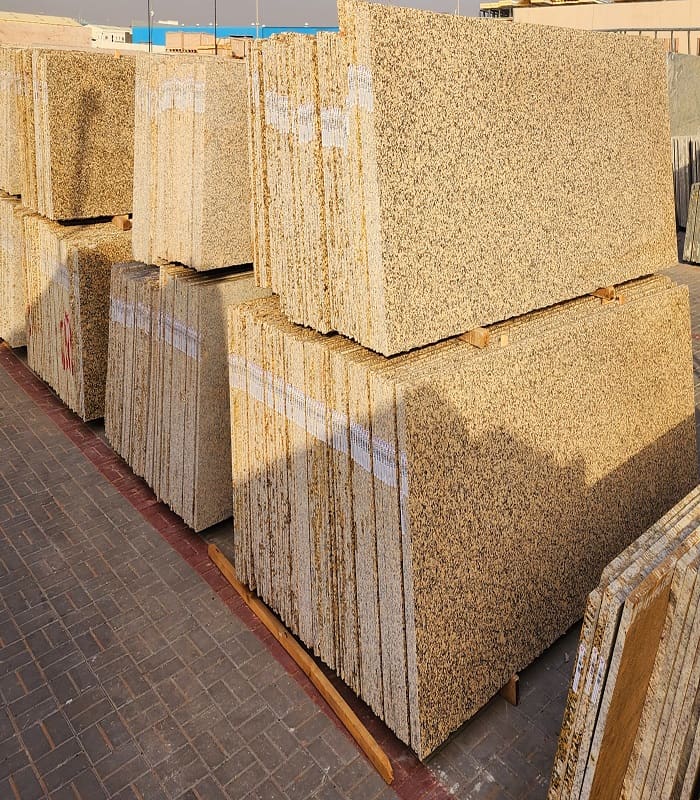
If you like the calm look of quartz, see our quartz range; some granites in the catalogue also have an even, low-key pattern: Absolute Black (a deep, even black), Velvet White (a very light grey-white with a fine speckle), Steel Grey (a dark steel-grey with a fine, even speckle) and Crystal Yellow (a yellow-gold with a uniform grain). For a white, marble-look surface, the porcelain slabs are another option to compare.
Care, repairs and fabrication
Quartz usually needs only routine cleaning with products its manufacturer approves; harsh chemicals and high-pH cleaners can damage the resin. Granite needs routine cleaning too, plus sealing if a water-drop test shows that the stone absorbs. The granite care guide walks through the test.
Chips on either material can often be filled by a skilled fabricator, though a repair on a patterned surface is rarely invisible.
Cutting any stone or stone-like surface releases fine crystalline silica dust, which is a serious health hazard for workers. Engineered quartz typically contains a much higher proportion of crystalline silica than natural granite, and Australia banned the use of engineered stone from July 2024 over worker-health concerns. Whatever you choose, use a fabricator who cuts wet and controls dust.
Which to choose
Stones Forever can quote for granite, marble, porcelain and quartz. Send us your shortlist and we will price the options side by side.
- Outdoor kitchen, terrace or strong direct sun: granite, in a lighter colour and a suitable finish.
- Many identical units that must match closely: quartz is simpler; with granite, plan the quantity from one lot.
- You want a unique natural pattern: granite, chosen from the actual slab.
- You never want to think about sealing: quartz, or a granite that tests as low-absorbing (retest periodically).
- You cook with very hot pans and do not want to use trivets: neither material should be treated that way, but granite is generally more tolerant of heat.
Questions
Does Stones Forever sell quartz?
Yes. Our quartz range has fifteen designs in the Calacatta, Carrara and Solid series, alongside natural granite, one marble (Dark Emperador) and five porcelain designs.
Is quartz stronger than granite?
Both are hard, durable worktop materials in normal use. Real differences depend on the specific product, so compare manufacturer data for a quartz and ask for any available data for a granite. The test results for our quartz range are listed on the quartz page.
Can quartz be used outdoors in the UAE?
Most quartz manufacturers do not recommend it, because prolonged UV exposure can discolour the resin. Granite is generally the more suitable choice outdoors.
Does granite need sealing like people say?
It depends on the stone. A water-drop test shows whether it absorbs. Some granites need sealing; dense ones may not. Retest from time to time.
This guide is general information about stone, not a specification for a particular project. Stones Forever does not publish test data it does not hold — ask us about documentation for a specific material.