Buying guide
Granite flooring in a hot climate
Short answer
For outdoor floors in the UAE, choose lighter granites with a textured finish, because dark polished stone absorbs the sun and becomes very hot, and polished surfaces are slippery when wet. Indoors, in air-conditioned rooms, polished granite works well as long as floors are kept dry. Confirm which finishes are available for your chosen material, and leave bedding and movement joints to a competent installer.
- Dark stone in direct sun gets much hotter than light stone; this matters for terraces, pool decks and walkways used barefoot.
- Polished granite is slippery when wet. Textured finishes such as flamed give more grip outdoors; honed is less slippery than polished but may not be enough for wet areas.
- Indoors, polished floors are fine in dry, air-conditioned spaces; use mats at entrances.
- Sun-exposed floors move with heat. Full bedding, movement joints and drainage falls matter as much as the stone.
Colour and surface heat
Any surface in direct UAE summer sun gets hot, but colour makes a large difference. Dark stone absorbs more of the sun's energy and can become uncomfortable or unsafe to touch with bare feet, while light stone reflects more and stays noticeably cooler. This is general physics rather than a property of one particular granite.
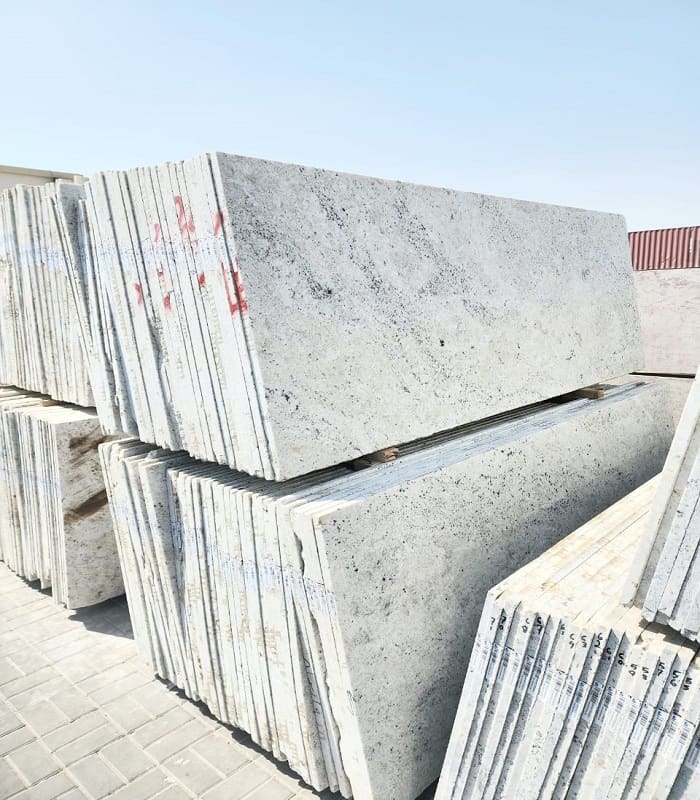
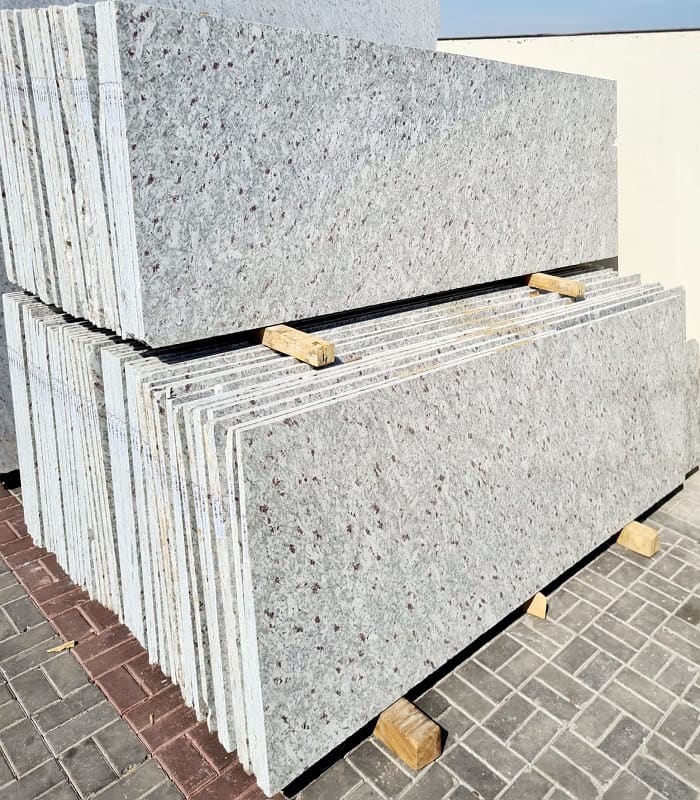
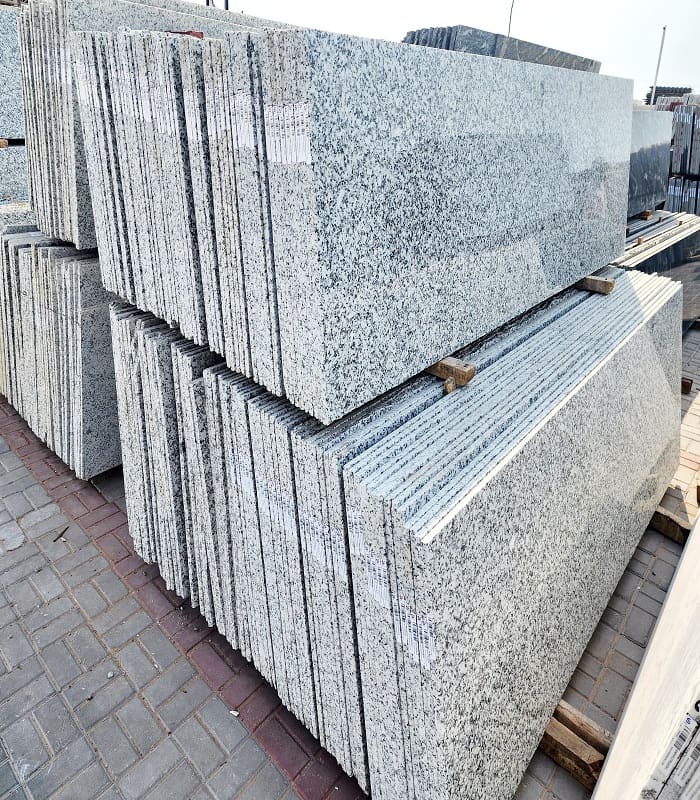
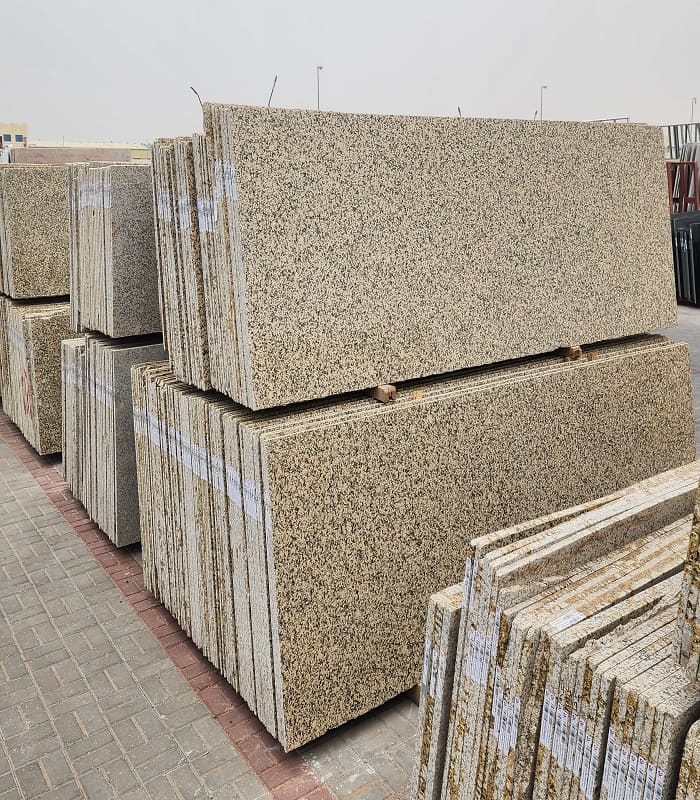
For pool surrounds, roof terraces, courtyards and walkways that people use barefoot, choose light or light-warm tones. Lighter granites in the catalogue include Colonial White, Moon White, Platinum White and Kashmir White, and warm light options such as Royal Cream. Dark stones such as Black Galaxy are better kept for shaded areas, interiors or details such as borders.
Grip and finishes
Polished granite has a smooth, reflective face. Dry and indoors it is practical; wet, it becomes slippery. Outdoors, where floors are washed, irrigated or splashed from a pool, a textured finish is usually chosen. Common options for granite include flamed (a heat-treated rough surface), bush-hammered and brushed or leathered. A honed (matt) finish is less slippery than polished, but may still not give enough grip in wet areas.
Finish availability is not recorded per product in the current catalogue, so confirm with Stones Forever whether the finish you want is available for the material and format. If your consultant specifies a slip-resistance rating, the stone will need testing in its finished state; Stones Forever does not currently hold slip test results. See the finishes guide for appearance and limitations of each.
Indoor versus outdoor at a glance
These are common practices, not a specification. Your consultant and installer decide joint layout, bedding and adhesives for the actual site.
| Indoor, air-conditioned | Outdoor, sun-exposed | |
|---|---|---|
| Colour | Any; dark stone works well | Light or light-warm tones stay cooler |
| Finish | Polished is common; keep floors dry | Textured (e.g. flamed); confirm availability |
| Main risks | Wet patches at entrances, kitchens and bathrooms | Surface heat, wet slipperiness, thermal movement, staining from irrigation water |
| Formats often used | 60 × 60 or 60 × 30 cm tiles, slabs cut to size | Tiles or cut-to-size slabs, often in 30 mm where loads are higher |
| Installation focus | Flat, fully bedded base; movement joints at perimeters | Full bedding, movement joints, drainage falls, exterior-grade materials |
Installation points for hot, sun-exposed floors
Some light-coloured granites contain iron-bearing minerals that can develop rusty spots if they stay wet for long periods. If a light stone will be in a constantly wet area, ask about the specific material and look at older installations of it if you can.
- Full bedding: stone should be fully supported, with no hollow spots under tiles. Voids are a common cause of cracked tiles.
- Movement joints: outdoor stone expands and contracts with daily temperature swings; perimeter and field movement joints let it move.
- Falls and drainage: water should run off, not sit on the surface. Standing water increases slipperiness and staining.
- Exterior-grade materials: adhesives, grouts and sealants rated for exterior use and heat.
- Sealing: decide after a water-drop test on the actual stone. Outdoor stone faces dust, irrigation water and pool chemicals.
- Timing: in summer, schedule work around the midday heat and protect fresh installations from direct sun while they cure, following product guidance.
Formats in the catalogue
Granite tiles are listed in 60 × 60 cm and 60 × 30 cm at 20 mm, 60 × 30 cm at 30 mm, and a narrow 60 × 10 cm strip at 20 mm. Materials listed as tiles include Colonial White, Platinum White, Mani White, Alaska White, Colonial Gold, Crystal Yellow, Shiva Gold, Rosy Pink and darker options such as Black Galaxy. Granite steps are listed at 30 mm, and slabs can be cut to size by a fabricator.
For most villa interiors, 20 mm tiles on a full bed are common. For driveways or areas carrying vehicles, ask an engineer to specify thickness and base. Read more on interior flooring and outdoor paving.
Questions
Does granite get hot in the sun?
Yes. All stone heats up in direct sun, and dark stone gets much hotter than light stone. Choose light tones for areas used barefoot.
Is polished granite suitable outdoors?
It is generally not recommended for wet or exposed outdoor floors because it is slippery when wet. A textured finish is the usual choice; confirm availability for your material.
Can granite be used around a swimming pool?
It is often used, in light colours with a textured finish, proper drainage falls and suitable sealing. Rinse off pool water regularly, and follow your consultant's specification for slip resistance.
Do I need to seal outdoor granite?
It depends on the stone. Do a water-drop test on the actual material; if water darkens it within a few minutes, sealing will help.
This guide is general information about stone, not a specification for a particular project. Stones Forever does not publish test data it does not hold — ask us about documentation for a specific material.