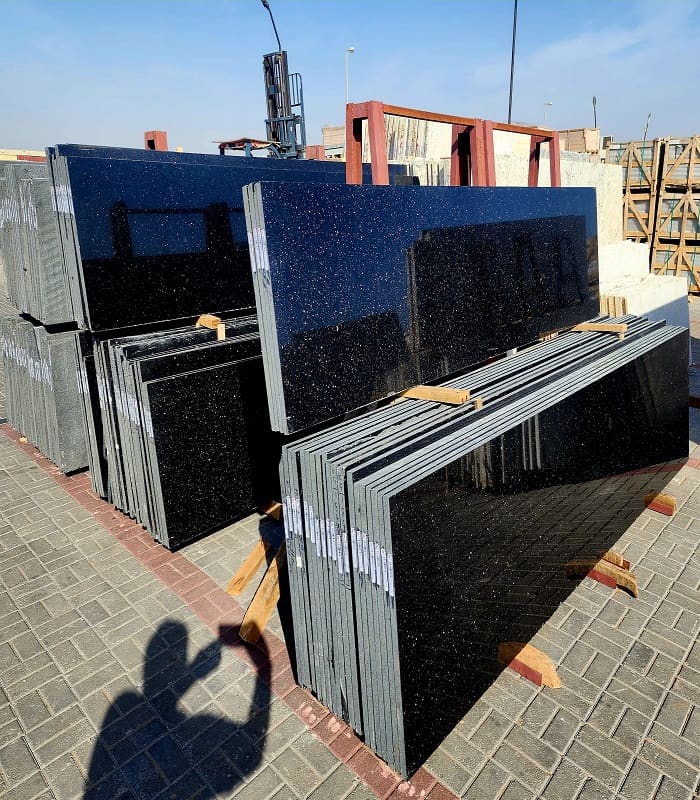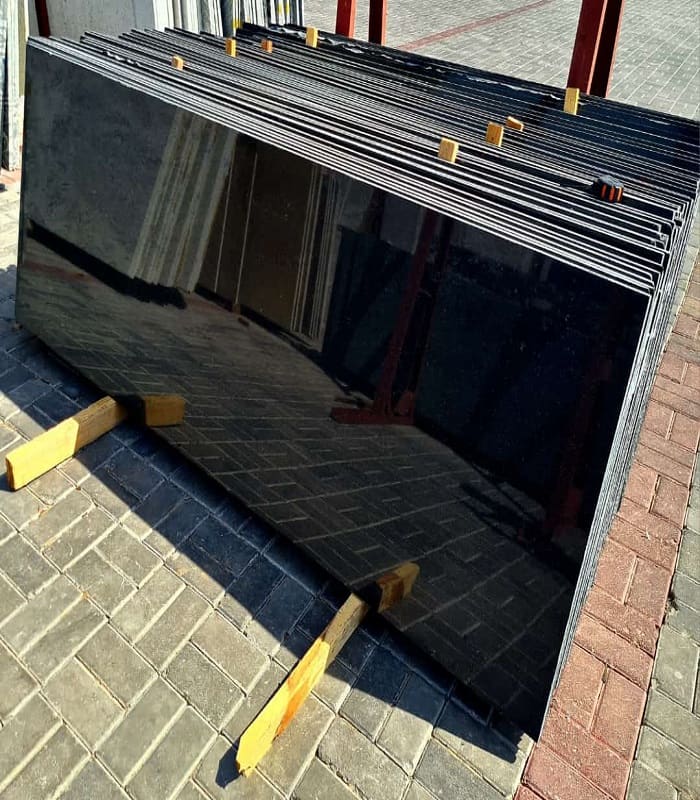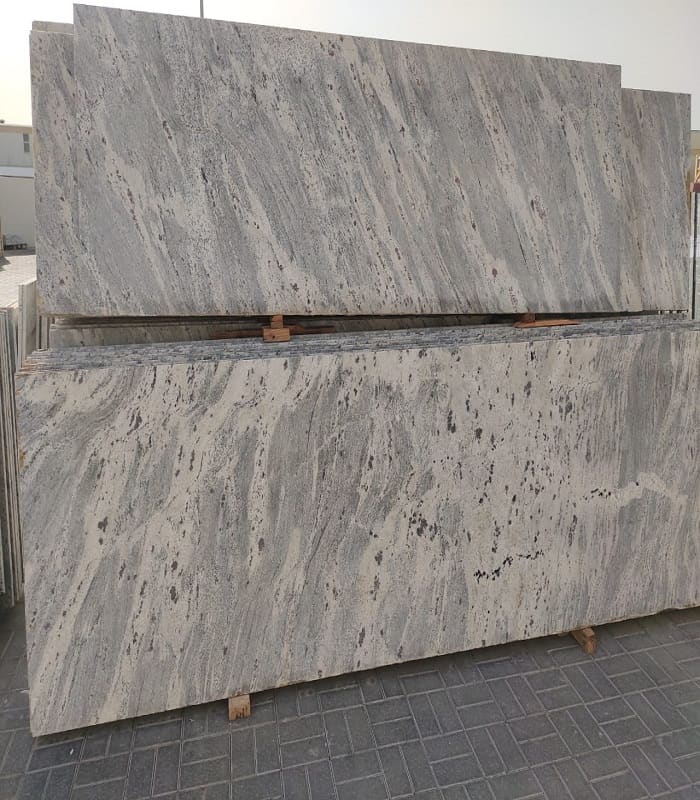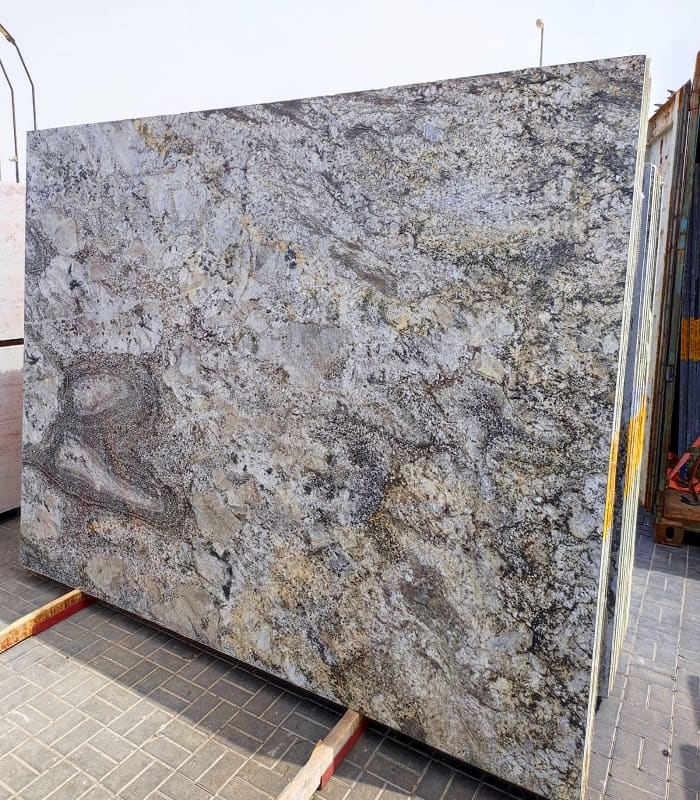
Buying guide
Granite thickness: 2 cm vs 3 cm
Short answer
2 cm (20 mm) granite is lighter and is common for flooring, cladding, vanities and worktops that sit on a full support with a built-up edge. 3 cm (30 mm) granite is stiffer and heavier, and is often chosen for kitchen worktops and overhangs without a full substrate. The final choice belongs to your fabricator or engineer, based on spans, supports and the specific stone.
- 30 mm is stiffer and heavier; 20 mm is lighter and easier to handle and fix.
- As a general figure, granite weighs roughly 52–56 kg/m² at 20 mm and 78–84 kg/m² at 30 mm.
- A 20 mm worktop is commonly laid on a continuous support and can be given a thicker-looking built-up edge.
- Most catalogue granites are listed in both thicknesses; tiles come in 20 mm or 30 mm, steps in 30 mm and porcelain slabs in 15 mm.
What 2 cm and 3 cm mean
"2 cm" and "3 cm" are the trade shorthand for 20 mm and 30 mm nominal slab thickness. Nominal is the key word: natural stone slabs have a manufacturing tolerance, and thickness can vary slightly across one slab and between slabs. If your detail is tight, for example flush with another floor finish, ask for the slabs to be measured at several points, or ask whether the material is calibrated.
The catalogue counts 62 products at 20 mm and 50 at 30 mm, plus the five porcelain designs at 15 mm.
Approximate weight
These are approximate general figures, calculated from a typical granite density of roughly 2.6–2.8 tonnes per cubic metre. They are not tested values for Stones Forever products, and the example slab size is illustrative only. Use them to plan handling, transport and cabinet loads; your fabricator or engineer should confirm anything structural.
| Thickness | Approx. weight per m² | Example: 3 m × 1.8 m slab |
|---|---|---|
| 20 mm | About 52–56 kg | About 280–300 kg |
| 30 mm | About 78–84 kg | About 420–450 kg |
Kitchen worktops
Many fabricators prefer 30 mm for kitchens because the extra stiffness lets the stone span cabinet frames, take sink and hob cut-outs and carry a modest overhang without a full board underneath. The trade-off is weight: cabinets and wall fixings must carry it, and installation needs more hands or lifting aids.
20 mm is also widely used for worktops, especially where the stone sits on a continuous support (commonly a moisture-resistant board) fixed to the cabinets. A built-up or laminated edge, where a strip of stone is bonded under the front edge, can make a 20 mm top look 40 mm thick or more while keeping the overall weight down.
Overhangs for breakfast bars and islands are where thickness matters most. How far a top can project unsupported depends on the stone, the thickness, the support and how it will be used. Ask your fabricator to specify brackets or supports; do not rely on a general rule.
Floors, walls, vanities and steps
These are common patterns in many projects, not rules. Site conditions, spans and local regulations decide the final specification.
- Interior flooring: 20 mm is common, laid on a full, solid bed. See interior flooring.
- Outdoor paving: 20 mm or 30 mm depending on traffic and base; anything carrying vehicles needs an engineer's specification. See outdoor paving.
- Wall cladding: 20 mm is common; external cladding needs a fixing system designed by a façade engineer. See exterior cladding.
- Bathroom vanities: 20 mm is common on a supported frame; 30 mm where a thicker top is preferred or the span is longer.
- Stair treads: thicker stone is usually preferred for treads; the catalogue lists granite steps at 30 mm.
Cost, handling and installation
A 30 mm slab contains half as much stone again as a 20 mm slab of the same size, so it is generally more expensive per square metre, heavier to deliver and harder to lift. Prices are given by quotation, so ask for both thicknesses if you are undecided.
Thinner stone is not automatically weaker in use: a properly supported 20 mm floor tile or vanity top performs well. Problems usually come from poor support, such as hollow spots under floor tiles or unsupported spans on worktops, rather than from the thickness itself. Slabs of either thickness must be carried and stored on edge; our delivery guide explains why.
Thicknesses in the catalogue
Most granites are listed in both 20 mm and 30 mm. At the time of writing, a few are listed in 20 mm only, including Imperial White, Kashmir White, Velvet White, River White and Prada Gold, and two in 30 mm only: Black Web and Blue Dunes.
Granite tiles are listed at 20 mm in 60 × 60, 60 × 30 and 60 × 10 cm, and at 30 mm in 60 × 30 cm. Granite steps are 30 mm. The porcelain slabs are 15 mm. Check the product page for the material you want, then confirm on your quotation.
Questions
Is 3 cm granite stronger than 2 cm?
A 30 mm slab is stiffer and can span further without support. A 20 mm slab on a proper full support performs well in most interior uses. Your fabricator or engineer should decide for spans and overhangs.
Can I use 2 cm granite for a kitchen worktop?
Yes, it is common, usually on a continuous support with a built-up edge if you want a thicker look. Ask your fabricator what support they recommend.
How heavy is a granite slab?
As an approximate general figure, about 52–56 kg per m² at 20 mm and 78–84 kg per m² at 30 mm. A full slab can weigh several hundred kilograms.
Which thicknesses does Stones Forever list?
Granite and marble slabs in 20 mm and 30 mm (most materials in both), tiles in 20 mm or 30 mm depending on size, steps in 30 mm and porcelain slabs in 15 mm.
This guide is general information about stone, not a specification for a particular project. Stones Forever does not publish test data it does not hold — ask us about documentation for a specific material.