Buying guide
Cutter slabs vs gangsaw slabs
Short answer
Gangsaw slabs are full-size slabs cut from whole blocks on large multi-blade frame saws; cutter slabs are narrower slabs produced on block-cutter machines. Gangsaw slabs suit large pieces with few joins, such as islands and feature walls; cutter slabs are widely used for standard worktops, steps, sills and cut-to-size work. Sizes vary by block, so ask for the actual dimensions of available slabs before you plan.
- Gangsaw slabs are cut from whole blocks and are large; cutter slabs are narrower and often more economical for repeated narrow pieces.
- As a general guide, gangsaw slabs are often around 2.7–3.2 m long and 1.6–2 m high; cutter slabs are commonly about 60–90 cm wide. Actual sizes vary.
- Bold, flowing patterns read best on a gangsaw slab; even, speckled stones work well in either format.
- The catalogue lists 56 cutter-slab products and 27 gangsaw-slab products; 11 materials appear in both formats.
How each format is cut
A quarry block of granite is typically several cubic metres of stone. There are two common ways to turn it into slabs.
A gangsaw is a large frame holding many parallel blades. A whole block is placed underneath and the blades cut through it slowly, producing a set of full-size slabs at once. Because every slab comes from the same block in sequence, a gangsaw set shows the stone's pattern across a large area and gives consecutive slabs that can sometimes be matched or bookmatched.
A block cutter uses large circular blades. Blocks, or pieces of blocks, are cut into narrower slabs (often called cutter slabs or "cutter size"). The process suits smaller or irregular blocks and is widely used to produce stone for worktops, steps, sills, thresholds and cut-to-size orders.
Typical sizes (general, not stock sizes)
These are general industry ranges only. Stones Forever's slabs vary by material and arrival, so ask for the measured length, height and thickness of the slabs actually available for the material you want. Remember to allow for the usable area: slab edges may be uneven and fabricators lose some stone to trimming.
| Gangsaw slab | Cutter slab | |
|---|---|---|
| Typical length | Often around 2.7–3.2 m | Up to roughly 2.4–3 m |
| Typical height / width | Often around 1.6–2 m | Commonly about 60–90 cm |
| How sizes vary | By block size and shape | By block and machine; edges may be sawn or natural |
| Pattern shown | Large continuous area of the stone | A narrower strip of the pattern |
| Typical uses | Islands, wide worktops, feature walls, bookmatched panels, large cladding pieces | Standard-depth worktops, vanities, steps, risers, sills, cut-to-size pieces |
Which format suits which job
Your fabricator will decide the final cut list. Give them the real slab dimensions so they can nest the pieces efficiently and tell you how many slabs you need.
- Kitchen worktops of standard depth (often 60–65 cm): cutter slabs commonly cover the depth in one piece. Long runs may need joints; plan where they fall.
- Kitchen islands deeper than a cutter slab: a gangsaw slab avoids a joint across the surface, or accept a planned joint.
- Stair treads and risers: cutter slabs are widely used, as are ready granite steps where the material is listed in that format.
- Bathroom vanities: usually cutter slabs, unless the vanity is unusually deep or long.
- Feature walls, large panels and bookmatching: gangsaw slabs, ideally consecutive slabs from one block.
- Window sills, thresholds, copings, skirting: cutter slabs cut to size are typical.
Pattern, joins and yield
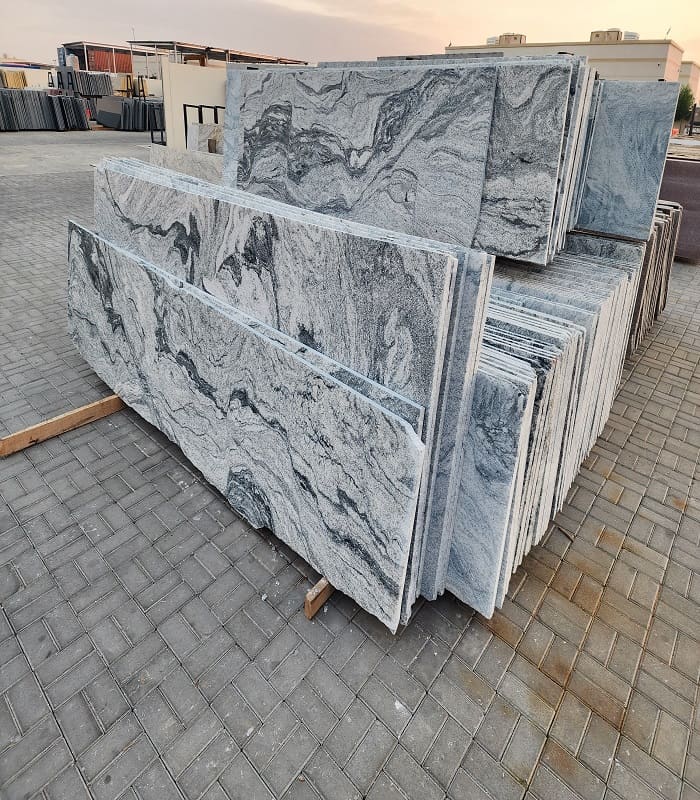
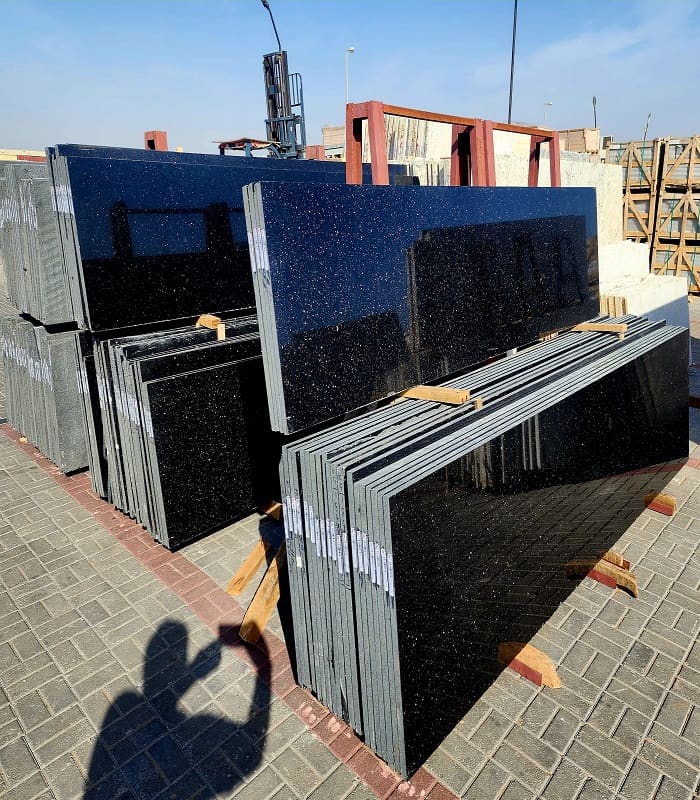
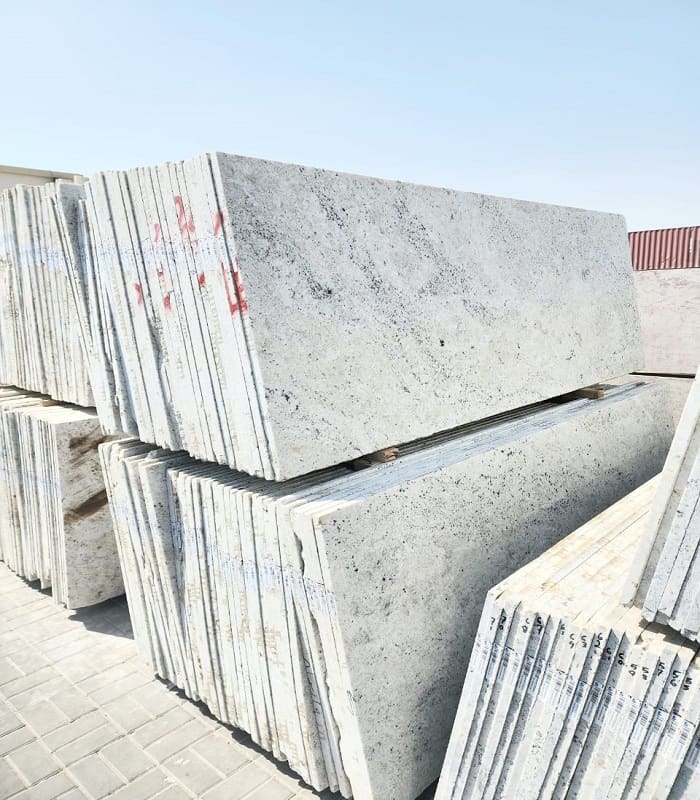
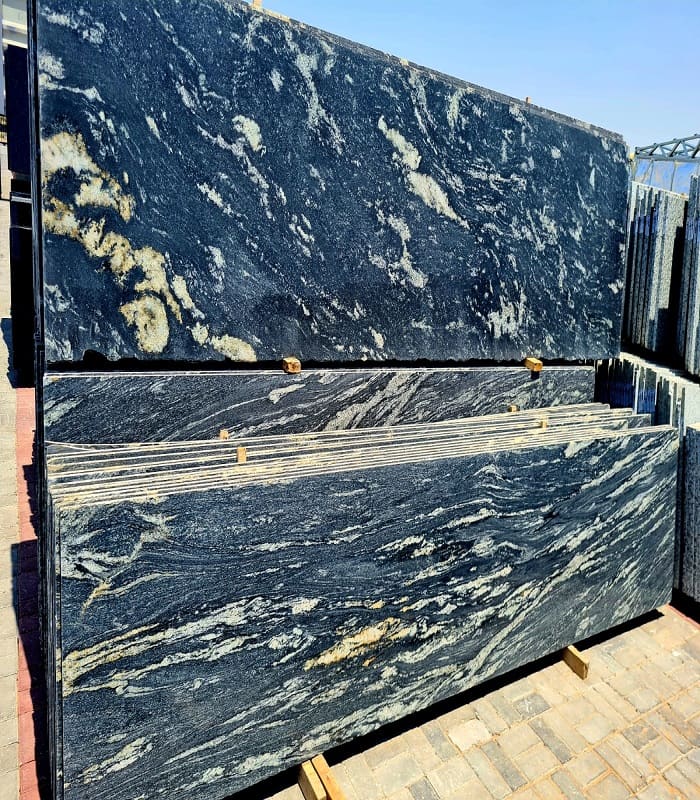
On an even, speckled stone such as Colonial White or Black Galaxy, a joint between two pieces is usually discreet, so cutter slabs are a sensible choice for most worktops. On stones with strong movement, such as Viscon White or Black Forest, a large gangsaw slab shows how the pattern travels and lets the fabricator position joints where they are least visible. Matching swirls across two narrow cutter pieces is harder.
Yield is the other factor. If your job is mostly narrow, repeated pieces, cutter slabs can mean less offcut. If you need one wide piece, buying several cutter slabs and joining them may cost you more in visible seams than a single gangsaw slab would cost in waste.
What the catalogue lists
At the time of writing, the catalogue lists 56 cutter-slab products and 27 gangsaw-slab products, most of them offered in both 20 mm and 30 mm. Eleven materials appear in both formats, including Absolute Black, Black Galaxy, Colonial White, Colonial Gold, Tan Brown and Viscon White. Some materials are listed only as gangsaw slabs, for example Black Web, Blue Dunes, River Black and Dark Emperador marble.
Browse by format on the cutter slabs and gangsaw slabs pages. The photographs on the site are yard photographs of real stock taken for the previous catalogue; current slabs of the same material may differ.
What to check before ordering
You can arrange to see slabs at the yard in Emirates Industrial City, Sharjah, or ask for a remote video viewing. Then send your list through the quote page.
- Measured length, height and thickness of each slab you will use.
- Whether the slabs come from the same block, and whether consecutive slabs are available if you need matching.
- The finish of the face, and whether the finish you want is available for that material.
- Natural fissures, filled pits, edge damage and any mesh or resin backing; ask so there are no surprises.
- How many slabs your fabricator needs once the cut list is drawn.
Questions
Is gangsaw better quality than cutter?
Not necessarily. The terms describe how and to what size the slab was cut, not its quality. Choose the format that suits the size and pattern of your pieces.
What size is a cutter slab?
Cutter slabs are commonly about 60–90 cm wide with lengths up to roughly 2.4–3 m, but sizes vary. Ask for the measured sizes of the slabs available for your material.
Can I get a kitchen island from one slab?
Often yes from a gangsaw slab, depending on the island size and the slabs available. Give your fabricator the island dimensions and the actual slab sizes.
Are cutter slabs cheaper?
Prices are given by quotation and depend on the material, format, thickness and quantity. For narrow pieces, cutter slabs can mean less wasted stone.
This guide is general information about stone, not a specification for a particular project. Stones Forever does not publish test data it does not hold — ask us about documentation for a specific material.